Showing posts with label Book Studies. Show all posts

Sunday, April 13, 2014

Desiring the Kingdom, and Exodus

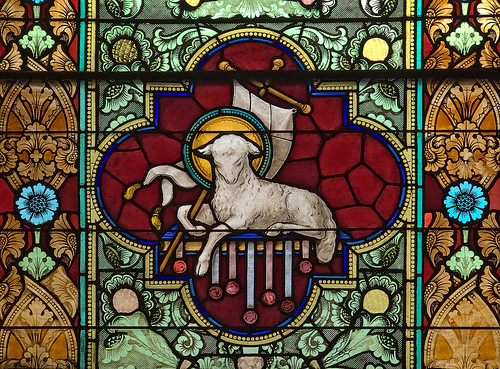
Saint Peter Roman Catholic Church, in Saint Charles, Missouri, USA - stained glass window of Lamb of God

Our local Catholic Bible Study group is studying Exodus right now, and in this week's lesson I came across a connection to Desiring the Kingdom that was helpful for me.

I don't vouch for the entire source, since I haven't studied it, but this PDF on Exodus has a section that makes a similar point to the one I read in the Exodus study guide.   It is about the connotation of the Hebrew word "avad" or "abad", which apparently means work but also worship, service but also liturgy:   

One of the central themes in Exodus is related to the Hebrew word avad . We first see this word in the characterization of how th e Egyptians persecute the Israelites. The Israelites were made to “serve with vigor.” 107 This word “to serve” is translated from the Hebrew word avad , which means “to serve,” but can also have the deeper meaning “to worship.” In fact, the word liturgy is derived from the Greek work for worship, leitourgia . Liturgy is to serve the Lord in wo rship. Pharaoh wants the Israelites to avad Pharaoh and the Egyptian gods, not the Lord. Sa dly, the reality is that this is exactly what has happened. The Israelites are enslaved in Egypt, but, as will become clear as the story develops, they are also spiritually ensl aved. They have entered the Egyptian culture of idolatry, paganism and polythe ism (the belief in many gods). Their physical slavery is an outward manifestation of their spiritual slavery. Throughout Exodus we will see that God calls Moses and the people to avad Him. Moses will lead the Israelites out of slavery in Egypt to avad the Lord.
You can find more analysis of the word at this source:  Is Work Worship?
If you want to see the word in Biblical context, go to this interlinear and then check the annotation.


Anyway, this solved a longstanding question in my mind:  Why the Benedictines call the Divine Office the Opus Dei, or "work of God".    It is also called the Liturgy of Hours. 

It also gives me some context for Josemaria Escriva's constant theme (which you also see in Francis de Sales, Brother Lawrence and many other sources) that the work of God is the work you are called to do at that particular moment in your life, and that this work can be sanctified -- it can be, in other words, a liturgy.

This section of Exodus also starkly depicts the same idea that Smith is trying to unpack in his book Desiring the Kingdom, that no practice is neutral, that God rightly claims it all.   Again and again, the text makes clear that Pharoah is claiming exactly what God claims, the Israelites' service and sacrifice.    And unlike King Darius in the story of Daniel, Pharoah is not trying directly to get the Israelites to worship him; rather, he is preventing them from worshipping God in the way God commands.

The Palm Sunday service in the Catholic Church always fascinates me because for this one occasion we break the Gospel reading into parts -- a narrator reads the main narrative, the priest says the words of Jesus, another man reads the parts of the various disciples, and the congregation reads the words of the people.    You can find the readings arranged for parts here , though it is different from the way our missal has it, and an explanation of the practice here.

This forces us (the congregation) to say things like:
“Prophesy for us, Christ: who is it that struck you?” and
(to Peter) “Surely you too are one of them; even your speech gives you away.”
and “Let him be crucified!” among other things that I most fervently pray I would never be tempted to say in real life.

However, it struck me that there is a kind of education in having to say such things.    Though we are members of the Body of Christ, we do confess our sins and transgressions and repent of them every time we go to Mass, and it never hurts to have it pointed out that the kinds of temptations that made the people say the things they did are exactly the same ones that are in our own sinful hearts.

 This roleplaying of evil is a kind of immersion into the depths of our own hearts, very suitable for this Holy Week, or at least, that is how I feel it.     As Chesterton says:  "What's wrong with the world?  I am." 

So getting back to Desiring the Kingdom, practices that we repeat again and again are the very substance of our lives.  I've noticed many times since converting (24 years ago this Easter) that when I read the Psalms over and over again, when I say the many traditional prayers commended to the Church, when I try to be more like Jesus, when I do things like go to Mass, sit down with my kids and begin the homeschool day, clean the toilets, or whatever, there is not infrequently big gap between my inner heart and what I am doing or saying.    However, the point is that I am "reforming", literally, by doing or saying these things.  

When Pharoah was forcing the Egyptians to work, he was forming their souls to some extent.  When God took the Israelites away, He freed them by reforming them towards their true selves, even though they often fought Him.   When we go to Mass or pray or do the duties of our state in life, we are being formed, if we let ourselves be.    In this way our work and our worship are intrinsically connected by the aim to which they lead.   


Thursday, April 3, 2014

Confessions about Desiring the Kingdom


I like James Smith's book Desiring the Kingdom and am enjoying the book discussion especially, but I admit to being a bit puzzled overall about how to fit it into my "corpus" of books about education.   


Some books fit onto my small shelf of pivotal educational books easily.    I think of Poetic Knowledge, Norms and Nobility, Beauty in the Word, Charlotte Mason's books, Implementing Ignatian Education in the Home, John Holt's books. 

This one hasn't, so much, not yet.   The part I am reading now is more a call to churches to take a closer look at their emphasis (and in a way, I can't help noticing, a call to churches to become more like the Catholic Church in its ideal form -- more embedded in history, more liturgical, more deeply ceremonial, more culturally awesome, more sacramental, more truly relational in the Trinitarian life, more truly philosophical, etc).   

But the book doesn't seem to have a close connection (yet) to what I am doing in my homeschool -- how I get up every morning, pray, drink my coffee, start the fire, plan my day, and get lessons ready to teach my kids.      It is written to those who are in charge of steering Christian society, or so it seems to me, and I am by no means one of those. 

However, this is not a criticism, just an acknowledgement of perplexity.   It is not the first time this has happened.   I've read other books that people were enthused about and I didn't get.   I've bought curricula that people raved about that sat on my shelf or flopped when I tried it out.   And sometimes, something that sat on my shelf suddenly makes sense and I can use it.   I had Latina Christiana for many years, wanting to like it and use it.  And now I m using it.    I couldn't understand lapbooks and now I get them (in my own way).

But what I am really trying to say is that someone on a classical yahoo group I am on linked to a follow-up thread to the old classic Circe thread that I read after I got sick last October.    And in turn, this led me to another resource -- a video talk by Jenny Rallens called The Liturgical Classroom.   I haven't finished listening to it yet, but it sounds like it connects the ideas from Desiring the Kingdom to daily life in the schoolroom and what you do with your kids.   Which has been the missing piece for me.   So maybe I will end up "getting" Desiring the Kingdom even if I am a little lost right now.

One thing I have gotten out of Rallens' talk so far (about 10 minutes in -- I have a short auditory attention span) that connects well to Smith's book is the idea that HOW teaching is done is of key importance.    If we want to help our kids order their affections properly, then it's like a whole new realm that we enter.    Sometimes I try to put myself in the hearts of people listening to Jesus.   How would He sound to a desperate sinner who saw no way out of the mass effect of his sins (like the thief on the cross?)  How would He sound to someone who crossed the Ts all his life in the comfortable certainty that this was the tribute he owed to God, and then found how much stranger and more immense the call was than he had thought?   

Teaching gives us the chance to enter that very realm every day.... the realm where everything is momentous and unexpected, and all our skills and intuitions and understanding are required.   The Kingdom of God, more amazing and terrifying than anything I would ever desire for myself.  My plans, aspirations, principles etc do give me a road-map and reality check but they don't give me a bubble-car to insulate myself in.      

What I really want, God, is a bubble-car, a comfort-zone I can carry around with me, but I accept that You don't want to form me into a bubble shape but into a truer icon of You.    I will have to remember that when I pray for the day in the morning that I am praying for You to work however You see best, whatever that implies in this particular day, and that my main call is to respond rather than to control or cope or withdraw.   

Tuesday, April 1, 2014

Desiring the Kingdom: Flourishing as a Human

I'm going to try to get back on the book study track with Desiring the Kingdom.    For this week, I am just going to write quick notes as they occur to me.

Go to Simply Convivial for links to more discussion.


1.  Christian worship as human flourishing

Christian worship, or the sum total of Christian liturgical practice, is not solely eschatological; it is also part of what it means to be human, in natural terms.

 "It is training for temporal, embodied human community."
 "Christian discipleship is the shape of what it means to be a renewed human being."

I suppose this is because we are not divided.  Since we are what we are, made in the image of God and incapable of true human development without Him, the only thing that can make a complete human naturally speaking is this supernatural element.


2.  Law, or God's Will for our lives.

"God's law is not a stern restriction of our will but an invitation to find peace and rest in what Augustine would call the "right ordering" of our will."   

Commandments are like guardrails.

Chesterton says this too.

“If men will not be governed by the Ten Commandments, they shall be governed by the ten thousand commandments” 
 Charlotte Mason often talks about the freedom of not being constantly thrown into the chaos of one's own untrammeled will and reason.

I was just reading Montessori's first Great Lesson, about Creation, where she talks about how everything is created for a purpose and their "goodness" is in fulfilling that purpose.  Only we (and once the angels) have the freedom to choose to do so, however.

3.   The Need for Confession

Because of our fallen human nature, we will fall down in our attempts to live by God's will.    The more we try, the more we realize our complete incapacity to live rightly on our own (another hint that man's natural flourishing can only be realized in a supernatural context).

Thus we need to repent regularly.

Repentance is not shame and it is not an impersonal acknowledgement of error.  It is a personal thing -- ultimately a realization of a breakdown in the relationship with God and a return to Him.

All sins come out eventually.   We seem to have a deep need to confess.   People reveal what they are continually -- I can't help think of the Reverend Dimmesdale in The Scarlet Letter as a kind of paradigm of this.

In a way, mystery stories are parables about how secret crimes are brought out into the open.

Only confession and repentance before God gives us hope, though.   One can't help contrasting Peter's temporary apostasy with Judas's.    This time of year, my kids and I seem to often ponder together what made the outcome so different.   Or, what made Saul different from David?

If there is anything that separates those that Jesus healed from those He accused, it is the way the broken sinners turned to Him while the whited sepulchers turned to their own road.

4.   Education

Some of the educational implications seem to be:

I. Christian formation is at the very heart of all education.    If one doesn't happen to have been brought up in the faith, then pursuit of truth, beauty and goodness as best as one knows how will probably do something to get one on the right path.     There is no true learning that doesn't involve the whole self, and indeed learning IS integration, and that is something that never completely happens, which is why learning continues for life.    Socrates composed poetry while in prison waiting to be executed.  

II.  It's impossible to learn without realizing what one doesn't know and wanting to overcome that ignorance.    This seems to parallel the need for repentance and confession in getting back on the right path in the life of grace.   Aquinas calls wonder a species of fear.    One desires knowledge because one is fleeing from ignorance and error.    Socrates said that "wisdom begins in wonder" and he felt that his key task was to make people realize that they didn't know or knew wrongly, in order to open the door to the possibility of true knowing. 

III.  Knowledge is ultimately relationship.   It's not just technical proficiency or a mental encyclopedia of facts.   It's an ordering of things, an interior that reflects the truth of how things are.    This involves more than the head, but the whole array of affections and resolutions.

For some reason I think here of the Anima Christi, which St Ignatius put at the front of his Spiritual Exercises, which is in fact a manual for integrating every thought, word and action of daily life into a wholly Christian liturgy:

Soul of Christ, sanctify me.
Body of Christ, save me.
Blood of Christ, inebriate me.
Water from the side of Christ, wash me.
Passion of Christ, strengthen me.
O good Jesus, hear me.
Within Thy wounds, hide me.
Separated from Thee let me never be.
From the malignant enemy, defend me.
At the hour of death, call me.
To come to Thee, bid me,
That I may praise Thee in the company
Of Thy Saints, for all eternity.
Also his Suscipe:

Take, O Lord, and receive my entire liberty, my memory, my understanding and my whole will. All that I am and all that I possess, Thou hast given me: I surrender it all to Thee to be disposed of according to Thy will. Give me only Thy love and Thy grace; with these I will be rich enough and will desire nothing more. Amen.


Tuesday, February 25, 2014

Desiring the Kingdom Book Club: Liturgy and Culture

Linking up with Mystie for this week's reading of Desiring the Kingdom.   Go to Week Eight for links to more discussion. 


I missed two weeks' reading and discussion while @Disneyworld/ # familydownwithsevererhinovirus so I had a fair bit of reading to catch up on.    However, the past couple of sections have basically all on the same train of thought -- the manifestations of "liturgy" in the secular arenas of the mall, the military/entertainment complex, and the university -- so it went pretty easily.

Smith critiques these secular liturgies for their insufficiency and disordered nature while also making what he calls an affirmation of "apologetic contact" for them.    They are vanities, but in some way we are seeking ultimate things in them even while losing our way in the shadows.   In this way he reflects Augustine:
Late have I loved you, O Beauty ever ancient, ever new, late have I loved you! You were within me, but I was outside, and it was there that I searched for you. In my unloveliness I plunged into the lovely things which you created. You were with me, but I was not with you. Created things kept me from you; yet if they had not been in you they would have not been at all.
Smith says:
Secular liturgies don't create our desire:  they point it, aim it, direct it at certain ends.
I will here admit that though this book is very thought-provoking, I get into some conceptual difficulties with some of his thinking.   In this reading, it was helpful for me to mentally substitute the words "enculturation" or "culture" for "liturgy".  I think this is because I tend to think of liturgy as a formal rhythmic or ritual manifestation of embodied doctrine, while the influences he talks about seem more parallel to cultic brainwashing to me.

A university has a culture.  The college my kids went to has a very different culture than the one described in the book.   A society has a culture.  The society we live in the present US is more like Brave New World than 1984.    A family has a culture.   Parents have a responsibility to shape the family culture. 


Perhaps it adds up to the same thing, liturgy and culture?  I am not sure about that.  Liturgy in the sense I am accustomed to is by its very nature directed to something higher than myself.  It invites but does not compel.    It provides a structure but not so much a propulsive force.    It is a series of actions rather than a submersion. 

The forces Smith describes in some of his examples remind me more of a bacchanal or a Roman circus, which is a surrender to something essentially lower than oneself but also more powerful.  


Now that I have said this, I will perhaps rethink my use of the word "culture."  Culture partakes of both of these, perhaps, including both the "lower" (sensory) and the "higher"(philosophical/meaning).  Culture is something like what Husserl called lifeworld or lebenswelt, the milieu which we swim in whether we are consciously aware of it or not.   Perhaps it relates to what Charlotte Mason called "atmosphere".    Culture is a complete experience and thus has a tendency to shape our thinking even while we are shaping it, but it does not directly co-opt it.  ... in a way, it is an embodiment of our desire and in that way our collective "child" but in another way, in that we are born of a culture, it is our parent.

I think this "culture as parent and child" is a useful way of thinking of our individual selves as a kind of nexus.   We can't choose our parents.  But we do choose what kind of parents we will be.

To put it another way, Chari and I have often discussed how we "educated ourselves" as children.  Growing up in the slightly ridiculous public schools of the 70's, we consciously chose something different.   In my case, this was partly due to the influence of my parents.  In Chari's case, not so much so.  We couldn't say that we weren't affected by our milieu, but we could both say that part of the effect was to point us away from it.  The point is that there is a dynamic between what happens to us and what we make of it.   Augustine talks about the flaws in his pagan schooling and family background but he also claims responsibility for what he did himself.    

Since this probably sounds a bit far from the point of this section of Smith's book, I will try to go to literary specifics.  

When Smith describes Charlotte Simmons' university experience in Tom Wolfe's book, which is very far from what she expected of a university as a sort of intellectual waypost of Athens, he is describing someone immersed in a milieu which rolls over the rational mind and forms the perspective in spite of one's interior resistance.   Charlotte feels herself losing her identity, her sense of self, in the barrage of physical and moral culture in the university.  Again, Smith uses the example of Winston in Orwell's 1984, who is compelled ultimately (by torture and brainwashing) not only to profess but to experience love for Big Brother.

This is what I would call the "cultic" experience in the modern sense of being brainwashed and overwhelmed by an environment consciously designed to subvert your freedom of will.  

This seems to me to contrast with Smith's other literary examples, of Charles Ryder in Brideshead Revisited and Tom More in Love in the Ruins, of men in the more Augustinian situation of chasing shadows of the divine reality.  Tom More loves women and whiskey more than God, but realizes that his weak "cupiditas" is a corruption of  true"caritas".  Ryder recognizes in his relationship to Sebastian an archetype or glimpse of what lies beyond and only can be seen in glimpses.    In this examples, the "enculturating" element takes a back seat to the idea of human as affective, desiring creature in search of something transcendent.... as a being who worships.

In the university and Big Brother examples, the "true" nature of the human is overwhelmed by force.   Charlotte and Winston are opposed to the environment they live in, but their inner integrity is basically violated in spite of themselves.  In the Brideshead and Love in the Ruins examples, the true nature of the human is disordered, easily turned from "Beauty Ancient and Ever New" to vanishing and unsatisfying worldly things of beauty.    So one example parallels Augustine's discussion of the rape victims in City of God, while the other parallels his discussion of his relationship with his mistress and the birth of a son as discussed in the Confessions. 

What both types of examples have in common is the acknowledgement that humans are more than minds, they are beings immersed in their environment and affected by it, that our "interiority" isn't as separate from our milieu as we might like to think -- that we are not dualistic "minds in machines".  Augustine can't be a saint while he is living with his mistress.    A rape victim's sense of self is deeply shaken even though she knows she did not consent to the act.  

But I think the "cultic" and "affective" examples given by Smith are radically different in that the cultic ones seem pessimistic about the essential nature of free will (which is what really annoyed me when I read 1984 a long time ago) while the "affective" examples actually hinge on free will and where we aim even while they take place in a concrete, physical environment.      I also couldn't help noticing that Orwell and Wolfe are secular social commentators, so their interest is more about what society does to individuals,  while Waugh and Percy are both Catholics and though social critics, are also more focused on what we might call Augustinian themes on what man does in light of his transcendent destiny. 

This is interesting stuff, though I haven't really pulled out anything practical yet to use in my little homeschool.   It made me think that in some ways, this concept of the human as more than a mind comes very intuitively to most homeschooling moms I know.     We are confronted, immersed in affectivity every moment of every day.   A baby is an icon of the affective nature of learning.    A mom is essentially the "kardia" of the family, the one who keeps things running and working.    According to some "attachment" theory, one of the caregiver's (primarily mom's) most essential roles is to "regulate" the child's affectivity, by providing a kind of emotional rudder that helps him bring order to the chaos of his environment.  I am not talking about lecturing or punishing, either -- the mom's very heartbeat as she holds an infant close helps regulate his own, and much of mothering is just this kind of "ruddering". 

In fact, it only occurred to me now, but Smith's train of thought quite seems to dignify the role of the wife as described in the controversial Ephesians passage which I have discussed before.    According to what he seems to be saying, the hand that rocks the cradle really does rule the world -- or if the wife and mother is the heart of the home, she is the one that in many ways essentially keeps the rest of the organism going.    I noticed while I was recovering from illness last fall that my testosterone-heavy household (all boys and men besides me) really felt the lack even of my sort of abstracted, vague, undemonstrative kind of presence.

It also made me think of how we don't want to "compel" our children per se --  that is not how God treats us.  He invites us, as in my opinion traditional liturgy invites us, to go beyond ourselves.    Charlotte Mason also talks about how we shouldn't appeal *exclusively* to our childrens' lower desires to influence them to do the right thing.  I like her qualifier there because, for example, Plato thought learning should be accomplished by way of games for the young, and Jewish teachers (so I read somewhere) gave pupils honey to taste on their first day of school so they would associate learning with sweetness.

Following through this is a semi-practical thought -- that my habits and daily work adds up to a kind of "liturgy" if I can only see it that way.  Too often like Charles Ryder I only get a glimpse, which is why I often have to remind myself.     It comes to my mind that this is one reason why our affective natures have traditionally thought important but also inextricably subordinated to our rational natures.   Affective impulses are often very fleeting.  How many people, like Augustine, have said, "Grant me continence, but not yet?"  It is our will (basically an intellectual appetite) and our reason that firms the impulses into resolve and thoughtful action.     This is another thing I have to revisit constantly:  ordering my affections properly and using them to help me to right thought and action.  

Head over to Simply Convivial for more discussion of this reading

Monday, February 24, 2014

Seven Posts in Seven Days: Day One, A Book Meme

 OK, Chari and I are going to play.


7 day blog challenge 7 posts, 7 days

 For Day One, I found this book meme by way of Faith at Household Diary  and thought I would play since I haven't been reading so much recently and want to get back to it.   I have been doing almost all my reading on my Kindle recently.   It's eminently portable, I can highlight passages and review them over at the Amazon site, and I don't have to shuffle through stacks (don't HAVE to -- I still shuffle through bookstacks for fun)

Chari, you should play! 


1. What book are you reading now?

I have several books going usually grouped by category.    Here are my categories.

OrganizationPaperless Home Organization by Mystie Winckler
Devotional/Doctrinal:  PRactical Piety of St Francis de Sales
Fictional/LiteraryTales from the Perilous Realm by JRR Tolkien
Homeschool-Related:  Books to Build On by ED Hirsch (probably will just browse through this for future reference rather than read cover to cover)
Great BooksOn the origin of species by Darwin, and Mind and Cosmos by Thomas Nagel.
Chesterton:  Heretics

2. What book did you just finish?

The Faithful One (a modern rendering of Job) -- a Kindle freebie.
Before that, Club of Queer Trades by Chesterton and The One Thing is Three. 


3. What do you plan to read next?

Rediscover Catholicism for our local Catholic book club
Mansfield Park by Jane Austen (rereading for this)
Whatever short story Chari has for March! LOL

4. What book do you keep meaning to finish?

The ones I am most pained about leaving right now are:
Both of them I got more than halfway through.   But I have to be in the right mental frame to read that kind of book, and sometimes it goes away in the middle.  

There are a lot more.   I want to read all the books on Kolbe's high school list but I keep getting sidetracked.    The main one of those I am frustrated about right now is Democracy in America. 

5. What book do you keep meaning to start?


Any Shakespeare play or Dickens book that I haven't already read.
Oh, and The Moonstone or Woman in White, since Faith keeps saying how much she likes Wilkie Collins!

6. What is your current reading trend?

While on vacation, I read mostly Kindle freebies.  Most of them cozy-ish mysteries (not the thrillers about pyschotic serial killers) and a few SF/fantasy.   

At home, I tend to have several fairly heavy books going at once.  Or if not heavy, then substantial practical manuals like Mystie's where I want to read slowly in order to actually apply the results : ).    Again, Kindle has been helpful for me in regard to serious reading.    I don't have to have a huge stack of weighty tomes to dig through, and my place is marked for me.  

If you try this meme, please let me know so I can read yours.  I love book posts.  

Tuesday, February 4, 2014

Desiring the Kingdom: "Would that it were already kindled!"

For this post, I am linking up with Mystie's Desiring the Kingdom Book Club.
Go to Week 5 for links to more discussion.  
"I came to cast fire upon the earth; and would that it were already kindled!" Luke 12: 49
The mass readings for today were about David and his son Absalom.    Absalom has rebelled against his father, but when news comes of his death, even though his followers expect him to feel triumphant, here is the response of David:
The king was shaken, and went up to the room over the city gate to weep. He said as he wept, “My son Absalom! My son, my son Absalom! If only I had died instead of you, Absalom, my son, my son!”
In the first place, I so empathize with how he felt.   

In the second place, I can't help reading David's words here (as they so often are in his Psalms) as a type, a figure of God's relationship to us.    You see it carried through in Hosea, and in the story of the Prodigal Son, and in God's own response to David, and in Our Lord's heartfelt words quoted above.   Pope Francis talks about it here.

That makes me realize how above all what grieves God, what the essence of our sinful nature IS, is not simply doing bad things, but our coldness and hardness of hearts.  What God is always working with throughout the Old Testament is replacing hearts of stone with real hearts, hearts like His, that respond to Him.

In that respect, the things we love in preference to God are like little barricades in our heart.      Even good things can become little barricades. 

If I see where I fail to respond fully, to be transformed, by this kind of love, then I see where I am like Absalom, or like David when he was blind to what he had done to Uriah and against God.    I also realize how completely incapable I am of any kind of proper response to this love, which is why the Gospel reading for today, concerning the healing of the woman with the issue of blood and the restoring from the dead of Jairus's daughter, is hopeful, because it gives me a way, through Jesus, who literally did what David wished he could do for Absalom -- died instead of me. 

This seems to me to connect with James Smith's message in Desiring the Kingdom.   The direction he is going is somewhat different, because he is describing how our rituals, our daily "liturgies", shape us without even our realization.

I am focusing mostly on the first part of the reading.   Smith uses the example of a movie I haven't seen, Moulin Rouge, to make the point that as Christians, believers, we are ultimately to be in love with God, a love that makes us eager to set the world on fire, to transform and let ourselves be transformed, not just building up a middle class edifice of proper living.    
 On the one hand, this seems to be the very antithesis of the kingdom of God: a realm of prostitutes and addicted artists given over to wanton pleasure-seeking. This criticism is embodied in the figure of Christian’s bourgeois father, who berates the bohemian culture for its sinfulness, which seems to be most linked to its failure to be “productive.” But to “the children of the revolution” (try to hear Bono crooning the song from the sound track), our highest calling is not to simply be producers. Instead, they are committed to the bohemian ideals of “beauty, freedom, truth, and above all, love.” And the spectacle of the film is ripe for analysis in terms of  (Charles) Williams’s theology of romantic love—a love that is revelatory, that breaks open the world .. Christians will tend to say, “Ah, but that’s not love—that’s eros, not agapÄ“!” But a romantic theology refuses the distinction... The end of learning is love; the path of discipleship is romantic.
Romantic, perhaps, but not sentimental.... I was thinking about why the "affective" nature of many Sunday school, youth group, Vacation Bible School, and Christian camp experiences tended to make me squirm uncomfortably rather than fall in love.   I think those large-group emotional experiences are often somewhat contrived and so not meaningful.       I think we had enough experiences with the bathos of a lot of 70's religious practice not to go back there.

But I take it that Smith is talking more in the tradition of CS Lewis and his friends.   Even our rationality needs to be thoroughly infused with caritas, with our response to the utterly unsentimental but deeply affective and relational call of God.

He goes on to make the point that in this light, even "neutral" behavior is underpinned with deep significance.    One person could chop vegetables because he is getting paid to do it, another out of love for her family, another because he knows his mom will get him in trouble if he shirks his chores.  In that light, exterior habits themselves are "thin" (just things you do customarily for whatever reason) but they get depth and resonance (he uses the term "thickness") by the underlying self that does them.

St Josemaria Escriva puts it this way
You are writing to me in the kitchen, by the stove. It is early afternoon. It is cold. By your side, your younger sister — the last one to discover the divine folly of living her Christian vocation to the full — is peeling potatoes. To all appearances — you think — her work is the same as before. And yet, what a difference there is!

—It is true: before she only peeled potatoes, now, she is sanctifying herself peeling potatoes.


Tuesday, January 28, 2014

Desiring the Kingdom Book Club: Contemplation and Affect and Desire

 Desiring the Kingdom Book Club


For this post on Desiring the Kingdom,  I am linking up with Mystie at Simply Convivial.
Go there for links to more discussion!


I mentioned a couple of posts ago that I never liked the idea of "worldview" teaching.   I think perhaps it was useful at a certain time in history for some Christians who didn't have a good sense of intellectual or cultural tradition to start with.  And I am sure, as with all partially good and enthusiastic efforts carried out by individuals, it did good things in many homes.

But too often, in my opinion, it became a substitute for the intellectual (and deeply creative and personal) work you have to do to integrate secular and religious realities.  It seemed too thin and "notional" (to use a word of Cardinal Newman's).   So in a way I was critical of worldview teaching for rational/cognitive reasons, and in that way, I came at it from a different perspective than Smith does in Desiring the Kingdom.  

But in another way, I think there is common ground, and it shows up in this section on the Social Imaginary.     From the book: 

(Charles) Taylor suggests a helpful analogy: The understanding implicit in practice is akin to knowing how to get around your neighborhood or town. This is a kind of know-how that is embedded in your adaptive unconscious......The “social imaginary” is an affective, noncognitive understanding of the world. It is described as an imaginary (rather than a theory) because it is fueled by the stuff of the imagination rather than the intellect: it is made up of, and embedded in, stories, narratives, myths, and icons. These visions capture our hearts and imaginations by “lining” our imagination, as it were—providing us with frameworks of “meaning” by which we make sense of our world and our calling in it. An irreducible understanding of the world resides in our intuitive, precognitive grasp of these stories....  And insofar as an understanding is implicit in practice, the practices of Christian worship are crucial—the sine qua non—for developing a distinctly Christian understanding of the world. The practices of Christian worship are the analogue of biking around the neighborhood, absorbing an understanding of our environment that is precognitive and becomes inscribed in our adaptive unconscious.
My homeschooling solution to the "worldview" question has always been to read stories, legends and myths with my children and to talk about them.     And a certain kind of simplicity of detail in household affairs and an environment fairly influenced by natural and liturgical rhythms of the season has made up for some, not all, my deficiencies as a teacher and mother. 

Yesterday while I was reading this section of the book, I made a list of adjectives and some nouns that Smith uses to describe the attributes of this social imaginary as opposed to the "mere worldview" context:

embodied, imaginative, desire, visceral, tactile, sensorial, story, communal, traditional, visionary, embedded, inarticulate, neighborhood know-how, pre-cognitive, religious (as opposed to theological), devotion

He sums it up as "desire forms knowledge" and makes the point that cultivation and culture are etymologically related, and that "poieses" or making is part of the same thing.

"Such a movement can occur in three kinds of poiesis: (1) Natural poiesis through sexual procreation, (2) poiesis in the city through the attainment of heroic fame, and, finally, (3) poiesis in the soul through the cultivation of virtue and knowledge."[  --Socrates, Symposium
I should really stop there but I have been reading a lot of philosophy recently and I just wanted to mention a few concepts that seem to relate to this train of thought.

Something that subliminally bothers me while I am reading this book is the recurrent dichotomy between the rational and the affective.    I see why he is making this distinction, and I know it is the framework which we seem to be stuck with ever since Descartes, and that he is trying to show us a way out by evoking it, but I think that talking in those terms can make it hard sometimes not to subliminally accept the very framework that he wants to break down.

Perhaps the Greek philosophers and medieval theologians were right in distinguishing between two kinds of reason -- intellectus and ratio.   Knowledge incorporates both these two things, to the classical and medieval philosopher, but the modern view of knowledge is simply "ratio"  -- the strenuous, chain-of-reasoning part of your thinking equipment.   If you have read your Josef Pieper, you probably have a sense of the difference.  

What these classical and Christian thinkers required for proper human flourishing was both ratio and intellectus. Knowledge was not possible without work (ratio) but it did not reside exclusively within the world of work: the fruits of ratio were a philosophical or spiritual knowledge of intellectual contemplation (intellectus). According to Pieper, the moderns made two mistakes in their conception of knowledge. On the one hand, some thought of knowledge only as the product of ratio (e.g., Kant, Marx, Weber); while others believed knowledge was simply passive and receptive in nature (e.g., romantics like Jacobi, Schlosser, and Stolberg). Genuine knowledge demanded both ratio and intellectus, work and contemplation, in our understanding of reality.
I think perhaps Smith is talking about roughly the same thing with his "affective" as the Thomists talk about with their "intellectus", or at least he incorporates this contemplative, receptive aspect of thought into his treatment of "social imaginary", but I think because he puts "intellectual" (in our modern use of the word as scholarly or academic) on the "worldview" side as opposed to the "social imaginary" side, there is danger of thinking that contemplation is on the rational, theoretical side of things, whereas it is actually in the very core of the "kardia" in my view.

To bring Ignatius in here, the Christian is ideally integrated -- ratio and intellectus, practice and doctrine.    If I had to boil all the modern papal encyclicals into one over-arching thesis or theme, it would be this idea of integration.    Each encyclical takes one aspect of the modern experience and filters it through a Catholic understanding of this thing's significance.     And this is not simply a proclamation of a worldview, but a summons to contemplation of the real meanings of things and how they are worked out in the "social imaginary."

Christians are in the position of being "in the world but not of it".    Their "collective intentionality" (to use a term from phenomenology, that Edith Stein wrote about, which basically means the "aboutness" of a group and in that way is similar to Taylor's "social imaginary")  has to be different from, but not isolated from, their larger social context.    Husserl, Stein's teacher, talks about one's lifeworld:

even at its deepest level, consciousness is already embedded in and operating in a world of meanings and pre-judgements that are socially, culturally, and historically constituted. Phenomenology thereby became the study not just of the pure consciousness and meanings of a transcendental ego, as in Husserl's earlier work, but of consciousness and meaning in context. The lifeworld is one of the more complicated concepts in phenomenology, mainly because of its status as both personal and intersubjective. Even if a person's historicity is intimately tied up with his lifeworld, and each person thus has a lifeworld, this doesn't necessarily mean that the lifeworld is a purely individual phenomenon. In keeping with the phenomenological notion of intersubjectivity, the lifeworld can be intersubjective even though each individual necessarily carries his own "personal" lifeworld ("homeworld"); meaning is intersubjectively accessible, and can be communicated (shared by one's "homecomrades"). However, a homeworld is also always limited by an alienworld. The internal "meanings" of this alienworld can be communicated, but can never be apprehended as alien; the alien can only be appropriated or assimilated into the lifeworld, and only understood on the background of the lifeworld.
Terms like "lifeworld" sound much better in German -- "lebenswelt"-- a language which allows for noun-synthesis without dorkiness   --- (in fact, it seems to me that your mother tongue  tends to shape the way you think about things -- sometimes surprising that we can communicate at all!).

Anyway, now I'm rambling, but to close this part of the book study, I would say that the track my thinking is on right now is that contemplation is the essence of desire.    Aquinas says:

Man’s ultimate happiness consists in the contemplation of truth, for this operation is specific to man and is shared with no other animals. Also it is not directed to any other end since the contemplation of truth is sought for its own sake.

And the highest contemplation of truth is in the beatific vision,.

In that way I would think of the "social imaginary" I desire for my children as contemplative, while agreeing completely that the embodied, sensory, story-oriented practices of faith can be an enormous aid to contemplation.   


But Aquinas does not disagree with Smith, because he agrees that the affective trumps the cognitive: 
"With respect to things that are above the soul, love (amor) is higher and nobler than knowledge; whereas in respect to those things that are below the soul, knowledge (cognitio) is more important"
 I think the Bible is (besides many other things) an indispensable handbook for this kind of embodied and imaginative practice of the faith.   It comprises story, history, proverbial wisdom, liturgy, and contemplation.   It makes manifest all the essence of the "pedagogy of desire", and in that way is Eucharistic and Christ-oriented from the first page to the last, as the Catechism points out

You recall that one and the same Word of God extends throughout Scripture, that it is one and the same Utterance that resounds in the mouths of all the sacred writers, since he who was in the beginning God with God has no need of separate syllables; for he is not subject to time--
Augustine.
 But that is a subject for another time, since I have already gone on too long!  

Tuesday, January 21, 2014

Desiring the Kingdom: Philosophy and Religion and Background

Desiring the Kingdom Book Club 
Go to Simply Convivial for more discussion of Desiring the Kingdom.    I diverged from topic quite a bit, as you will see, but it was fun and will be useful for me at least as reference.   

Since I am going to be hanging out with James KA Smith until past Easter, via Mystie's book club study of Desiring the Kingdom, I thought I would research a bit where he comes from.   Usually when I am involved in a book discussion, as with Poetic Knowledge and Abolition of Man and Leisure, the Basis of Culture, and Happy Are You Poor,  I have already read the book and know the author like a friend.

In this case I know some of the other book discussion participants as friends : ) and we have discussed several other books together, but the author is new to me.   So here follows a contextual rabbit trail of Smith's biographical and academic history and his theological and philosophical foundation, at least insofar as they can be discovered on the internet.

If you want the short summary, I will say I admired what I found of our author.   Though he is not a Catholic, and I am one, a lot of his thinking and work intersects with the work and thinking of Catholic philosophers and theologians.   What's more, it turns out that this book's influences dovetails with some of the other things I am reading at the moment.

Details follow.  

Spatio-temporally speaking, Smith comes from Canada,  and received his education in America.   You can find more biographical details at Wikipedia.   He presently teaches at Calvin College, though he had a brief stint at Loyola Marymount in California.   According to Wikipedia, he is only in his mid 40's.     He must have amazing intellectual energy because he has already written several books and many articles which you can see across the web.   And they are on very substantial topics.   He seems to be well respected as a philosopher, a theologian, and a think-tank religious commentator.

Theologically speaking, Smith is a vigorous Calvinist, what some places on the web call a neo-Calvinist.   Or in some other places, a proponent of Radical Orthodoxy, though Wikipedia says he has moved away from that terminology recently. 

More links to academic/religious connections: 

Now, Smith's background is in philosophy -- specifically, French continental philosophy.    He has written several books and articles on postmodern thinkers such as Jacques Derrida.    This book on The Influence of Augustine on Heidegger: The Emergence of an Augustinian Phenomenology,
in which Smith contributes a chapter, puts me into severe "I want that book!" mode but unfortunately it is OOP and big $$ at Amazon.        

You can find a PDF article by Smith on Continental Philosophy and Religion here.     Such philosophers as Karol Wojtyla (John Paul II) and Edith Stein were also trained in continental philosophy, and much of both their work is influenced by the phenomenology of Husserl, who also was a heavy influence on Heidegger.     Whether Thomism and phenomenology can be reconciled is a topic of much interest to me right now, and though Smith's focus comes from a different perspective, he is definitely playing in that same intriguing field.

If I were to try to trace a cursory  profile of James KA Smith from my couple of hours searching across the web, I would say he has a very strong disposition towards integration of very disparate traditions, and the intellectual strength to make it happen.   Because he is a strong and out of the ordinary thinker, his opinions are sometimes controversial to the different communities he engages with.     (here is a PDF paper on Augustine, Heidegger, and Bultmann in which the writer engages Smith's thoughts, and I found quite a lot of blogs, articles and other works that discussed Smith's thinking).     "Controversial" is probably the wrong word, since Smith doesn't come off as a controversialist.   Rather, he tends to shed new light on old questions, or so it seems. 

He is by no means a Catholic, but he has written quite a lot on "catholicism" in the Reformed Apostles-Creed sense:

"Lift Up Your Hearts":  John Calvin's Catholic Faith
(he admits a debt to George Weigel here)
"Remember that you are Catholic" 
why Calvinists shouldn't choke on or leave out the "Catholic" part of the creed.
A Divided Church for the Common Good?
A call for the restoration of a more universal idea of the Church.

He has also written on the Catholic Church, and all the articles seem to be generally favorable:
Pope John Paul II:  A Reformed Appreciation
A Protestant Appreciation of Lumen Fidei

How (Not) To Be Secular 
This is a book he is writing on notable philosopher Charles Taylor,  a "practicing Roman Catholic" (according to Wikipedia) and author of a book called The Secular Society.    I want those books too. 

Here he writes in a slightly more critical vein:
Whose Rome? Which Catholicism?
About Francis Beckwith's Return to Rome.
(even though he draws a sharp distinction between two different "types" in Catholicism, and doesn't sympathize with Beckwith's "type", he also semi-admits that he feels some attraction to the shores of the Tiber himself) 

Below, you can see some of the conversation I mentioned above -- not "controversy" in the polemic sense but rather discussion of Smiths' point of view:


Let me add that I have not read through all the blogs and articles I linked to!  I am making this list partly for my own reference.

My general sense is that Smith is someone who takes the future of the Christian church as a whole very seriously, and that he is a seeker after truth.    Though my search wasn't comprehensive, I didn't find anything unfair or unidealistic among all his writings -- which makes me admire his brand of "catholic" Calvinism, even while I'm thankful that I am giving a shout-out from the other side of the Tiber.

So there is my little rabbit trail for this week.   If you wondered why I pasted so many links on Heidegger and phenomenology and the like, it is because I am reading phenomenology this year.   I already mentioned I am struggling through Heidegger's Being and Time.  If I survive, maybe I will be wiser.   In order to help me through Heidegger, I am reading a really really good book (really!) called Mind, Reason, and Being in Time.    It's a discussion of an apparently rather famous debate between two philosophers, Hubert Dreyfus and John McDowell, on what it means to "be in the world".    It even contains a chapter by Charles Taylor, though I didn't know when I read the chapter that he was a Christian philosopher. 

This topic of "being in the world" of course is very much to do with what Smith is discussing in this chapter.    When I realized how my reading was converging into one theme, I felt exactly as if God had reached down and given me a blessing.

I will just end with a few of the quotes that struck me from this section of Desiring the Kingdom, especially in relation to Heidegger and phenomenology:


As a result, significant parts of who we are—in particular, our noncognitive ways of being-in-the-world that are more closely tethered to our embodiment or animality—tend to drop off the radar or are treated as nonessential. In another sense, we could say such models are too static; they tend to treat the human person as the sort of thing that can be captured in a snapshot. In the same way that our embodiment drops out of the picture, so too does our temporality: if humans are conceived almost as beings without bodies, then they also are portrayed as creatures without histories, without any sense of unfolding and development over time.....


This Augustinian model of human persons resists the rationalism and quasi-rationalism of the earlier models by shifting the center of gravity of human identity, as it were, down from the heady regions of mind closer to the central regions of our bodies, in particular, our kardia—our gut or heart. The point is to emphasize that the way we inhabit the world is not primarily as thinkers, or even believers, but as more affective, embodied creatures who make our way in the world more by feeling our way around it. Like the blind men pictured in Rembrandt’s sketches, for the most part we make our way in the world with hands outstretched, in an almost tactile groping with our bodies.[13] One might say that in our everyday, mundane being-in-the-world, we don’t lead with our head, so to speak; we lead out with our heart and hands.....


Primarily and for the most part, do we think about the world? Or do we most of the time intend the world in some other way? Heidegger argued that Husserl—in Cartesian fashion[15]—tended to see humans as primarily cognitive or rational animals, as if we fundamentally and for the most part intended the world in the mode of thinking or perception. Heidegger thought that Husserl’s account of intentionality was reductionist in a way not unlike our critique of the models above: Husserl tended to reduce the richness and complexity of our lived experience to mere perception or cognition, thus reducing the texture of the world to a collection of “objects”—as if we went around all day perceiving chairs and perceiving our friends, rather than sitting on chairs and embracing our friends while engaged in much more interesting ways of inhabiting the world. In contrast, Heidegger argued that primarily and for the most part, we don’t think about a world of objects; rather, we are involved with the world as traditioned actors.

The world is the environment in which we swim, not a picture that we look at as distanced observers.[16] Thus, rather than suggesting that perception or mere cognition is the fundamental mode of intentional consciousness, Heidegger argued that care is the most primordial way that we “intend” the world.[17] With this, Heidegger made a critical move: he shifted the center of gravity of the human person from the cognitive to the noncognitive—from the head to something like the heart, from the cerebral regions of mind to the more affective region of the body.[18] For Heidegger, we might say that I don’t think my way through the world, I feel my way around it. With this shift, Heidegger both signaled the influence of Augustine (and a later Augustinian, Pascal) and began to articulate an anthropology that was an alternative to the cognitivist paradigms that had dominated the scene up to that point (and that remain operative in the person-as-thinker and person-as-believer models noted above).

Small note -- though I am no expert, I have read some of both Husserl and Heidegger.   I am not qualified to say whether  Husserl was more Cartesian or "dualistic" in his approach to phenomenology, but from the little I know, I can't help wondering whether this is really the case.

 Husserl's writing style is way more "embodied" than Heidegger's.   Husserl was a Christian convert and a deep influence on Edith Stein, who was martyred by the Nazis, while Heidegger joined the Nazi party (though in fairness he later expressed regret), didn't treat his mentor Husserl very well, and apparently played rather a dirty trick on Stein in addition.   Those are my admittedly Kardic or heart /gut/ woman's intuition reaction to the thing, but I liked Husserl when I read him (Liam gave me one of his college books which contained a Husserl essay) and I don't particularly like Heidegger so far.

This last part doesn't have much to do with DtK, but I wanted to write it down while I was thinking about it!




Tuesday, January 14, 2014

Desiring the Kingdom: Liturgy and Kardia

 I am joining with Mystie and others for Week 2 of this book study.
Liturgies aim our love to different ends precisely by training our hearts through our bodies. They prime us to approach the world in a certain way, to value certain things, to aim for certain goals, to pursue certain dreams, to work together on certain projects. In short, every liturgy constitutes a pedagogy that teaches us, in all sorts of precognitive ways, to be a certain kind of person. Hence every liturgy is an education, and embedded in every liturgy is an implicit worldview or “understanding” of the world.
Etymologically, the word "liturgy" means public worship, duty, ministry.   But Smith seems to use it in a somewhat fuller sense, as something that calls on every element of the human, not just his head.    His use of the word "kardia" is to show the deeper Christian meaning of the "heart" as not just what we put on a Valentine card but as the core of the human being as human.

Sean has been working on this 3D puzzle of New York's famous St Patrick Cathedral.


This has inspired in Aidan one of his regular Google forays into what he calls "Mass" -- which means he wants to browse distinguished churches.   Here is an inside view of the cathedral, which Aidan had me look up.


Think about traditional forms of worship, the kind that would have taken place when St Patrick's Cathedral was new, or in European village churches or city cathedrals.   In addition to this kind of appeal to the sight, there was music (think of the sacred music of Bach, Handel et al),  music of human voice in chorus and old pipe organs.  Then there was the smell of incense; the richness of vestment and receptacle; the chanted Latin; the careful, ceremonious rubrics of placement and movement required of the priest, his attendants and the congregation.   All were different from the everyday, all dignified, all carefully ordered, all mysterious though deeply embedded in history.   Mystery does not take away from meaning -- it adds to it.   Tradition does not impersonalize -- it calls for a deeply personal response within the specific meaning of that tradition.

Smith wryly describes an ordinary American mall detail by detail, paralleling this traditional liturgical experience -- the preparation, the hush of entrance, the music piped throughout, the little vestibules of worship, the iconry, the sense of lifting up the heart in aspiration and reverence, the rituals of approaching the commercial altar with your offering of cash in exchange for gifts that bring hope and a sense of transcending the ordinary.     Even the mystery and the traditional continuity -- every mall partakes of something of the essence of ALL malls.

This has stuck with me, though we go so seldom to malls that really, we couldn't say we were "practicing mall-goers" in a poll.    We are at the very best, Easter and Christmas mall attenders and perhaps not even that.   I actually don't remember the last time we mall-cruised.

Still, there are other liturgies involved in typical American life.   Smith's point is to bring out that what we receive with our whole selves, what we love, is what we essentially become.

The liturgy is a “hearts and minds” strategy, a pedagogy that trains us as disciples precisely by putting our bodies through a regimen of repeated practices that get hold of our heart and “aim” our love toward the kingdom of God. Before we articulate a worldview, we worship. Before we put into words the lineaments of an ontology or an epistemology, we pray for God’s healing and illumination. Before we theorize the nature of God, we sing his praises. Before we express moral principles, we receive forgiveness. Before we codify the doctrine of Christ’s two natures, we receive the body of Christ in the Eucharist. Before we think, we pray. 

He calls the typical Christian focus "bobbleheaded".    I instantly pictured one of those cartoony story Bibles designed for children.   I always wondered how that became a good idea, but perhaps it is a true art, representational of a certain mindset.

A while ago while driving up to Oregon, Kevin and I listened to a Teaching Company series on neurology that included a lecture on our mental "body map".    I couldn't find a link that dealt specifically with this idea (though I did find a cool human emotion body map article).  But according to the lecture our internal mental images of our body are distorted.  Our faces and hands are disproportionately exaggerated, etc.

Smith's point is that we usually target Christian education disproportionately to the head, therefore implicitly envisioning a bobble-headed Christian.     He states that Protestants are particularly guilty of this, as opposed presumably to Catholics and Orthodox.    That could be true, but I think his cautionary words apply to Catholics as well, if only as a warning.

He points to "worldview teaching" as an example.   I have been around long enough to remember when "worldview" was really trending in the Christian homeschool world, particularly in Protestant circles.   And yes, I was always suspicious of basically mainlining a specific philosophy straight into a central vein of the brain, so to speak.    As Smith says, education is a matter of formation rather than information, even very good information.   (This is a traditional Ignatian motto).

Formation is something that involves an acknowledgment of every aspect of the human person, not just the cerebral processes.     It takes not just a set of words but a whole manner of life, and the manner of life cannot in turn be enclosed and boundaried by reason, but has to extend outwards into mystery, into what we can never fully grasp but can love and desire.

I like the way the book uses liturgy as a focus.    Liturgy involves habitual action.   It is repetitive in some ways, though there is variety within the repetition.   But you can do something habitually for many years and still walk away from it, if it isn't also associated with love.   Love in the liturgical context is a kind of reverence, a response of aspiration and commitment.

I grew up in an evangelical church which had a strong emphasis on the affective.   In many ways I am very glad of this, though it bothered me often as I grew older because sometimes the appeal to the heart was, well, just stupid --  an offense to my intellect.      You can mainline emotion as well as information.   Emotion can become reductive and crass in an attempt to bypass the intellect.   The American emotional excesses in regard to religion are well known -- and Jesus warned us not to become addicted to the sugar rush of emotion.

Liturgy at its best does not affront reason, it integrates it with the affections and raises it out of the cranky narrowness of the reason alone (Chesterton, Charlotte Mason, and CS Lewis all talk in very different ways about the excesses and deficits of over -reliance on brain without -- take your pick ---  poetry, mystery, atmosphere, the heart, the chest.).  Liturgy ennobles the affective.  This is why church liturgical commitees don't do us any favors by reaching for the banal middle ground with regard to music, rubrics, and church decorations.   We don't need to be "normed" in our religious practices; we need our hearts to be lifted, in the words from the Eucharistic service.

I am sure the book goes more fully into this -- we are only in Part 1.

I have been thinking a lot about the liturgy of the internet : ), the liturgy of house-keeping, the liturgy of the daily schedule around here.   And how our home and our daily doings contribute to the attitude I want my kids to have access to for their whole lives.   No specifics, yet.

We are what we love, and our love is shaped, primed, and aimed by liturgical practices that take hold of our gut and aim our heart to certain ends. So we are not primarily homo rationale or homo faber or homo economicus; we are not even generically homo religiosis. We are more concretely homo liturgicus; humans are those animals that are religious animals not because we are primarily believing animals but because we are liturgical animals—embodied, practicing creatures whose love/desire is aimed at something ultimate.

Wednesday, January 8, 2014

Desiring the Kingdom: The Spaces of Education


Desiring the Kingdom Book Club

Mystie at Simply Convivial is hosting a book discussion on a book called Desiring the Kingdom.

 ~details here~

I'm in.  Because I really need one more book to read (!)

And also because I seem to do better homeschooling when I have "something to love, something to do, something to think about" (Charlotte Mason).      

Since I just acquired the book a day or so ago I don't have much to write about, so I thought I would just put down some quotes I liked:

---------------------

Quotes from Desiring the Kingdom


"What if .................
.......education, including higher education, is not primarily[about the absorption of ideas and information, but about the formation of hearts and desires?
"What if ....................we began by appreciating how education not only gets into our head but also (and more fundamentally) grabs us by the gut—what the New Testament refers to as kardia, “the heart”?"

"What if...............
.......... education wasn’t first and foremost about what we know, but about what we love?
"That actually is the wager of this book: It is an invitation to re-vision Christian education as a formative rather than just an informative project.
It is an invitation to what we’ll call an “adventure in philosophical anthropology”; its root conviction is that how we think about education is inextricably linked to how we think about human persons."


".....I think we’ll also have to broaden our sense about the “spaces” of education. 
If education is primarily formation—and more specifically, the formation of our desires—then that means education is happening all over the place (for good and ill)."


----------------------------

I love that phrase: 


That's almost like the subtitle of my homeschooling adventures, in some ways!


Tuesday, December 3, 2013

Cross of Ages


Side Note:   I think I got Chari's Christmas Literature Evening list working on Google Drive.  If you check it out, let us know if it is working or not. 

I recently read a book called When Will My Grown Up Kid Grow Up?   It speaks to the concern many parents have nowadays about "boomerang kids" and slow transitions out into the world.  

According to this book, our society has become more like the hobbits of the Shire in one way -- that kids generally take longer to mature and become adults in their own right (in the Shire, adulthood comes at age 33, while according to this book, the time frame is more like age 27 to 29).

This puts a burden on parents who expected to find life easier in their 50's and 60's and instead are still partially supporting and involved with  adult children as well as possibly aging parents.    And this in a tough economic climate where these middle aged parents may be facing financial problems of their own and possibly marriage strain or divorce.  Plus, the adult kids may well be in situations that worry the parents aside from the economics -- living in unstable relationships, involved in drugs, wasting their lives online, etc (this part isn't much like the Shire, where immature folly seems to wear a more innocent and idyllic aspect).

The book presents an optimistic view of the phenomenon of adult children's slow transition to independence.  It gives lots of examples of different scenarios, plenty of helpful hints for the parents, and a generally hopeful perspective.  It assures the parents that if you can financially and emotionally weather the long transition, by the late 20's the majority of adult children HAVE found some sort of stability and a life of their own.       I didn't agree with everything in the book by any means (for example, the accepting attitude that every young adult nowadays "lives together" with someone pre-marriage, etc ). but I thought it was worth reading as a social commentary even if you are not having the difficulties described in the book.

It also points out that this slower transition can aid in strengthening relationships between adult children and their parents.   Sure, there are also relationship tensions and the possibility of enabling problem behaviors, but people in the 20's are usually more willing than teenagers to see the other side of things and recognize what their parents are dealing with.

The reason I'm writing this  is because I read this book soon after I read the biography of Jane Franklin (Benjamin Franklin's younger sister) and the contrast underlined something I have suspected for quite a while -- this type of situation is not new.    In fact, I think we have just come out of an artificial economic/social bubble and so what looks to us like current social dysfunction is actually closer to the historical norm than, say, the 50's, when most adult children were better educated than their parents and could walk out the door of their childhood home and easily find a comfortable job that would support them until retirement with a pension.

Our expectations are rather skewed by this, possibly, whereas in other times and other places in the world, where often several generations are deeply intertwined economically and socially and one's future life is by no means a secure thing.  

(Obviously, there are new things like technology that complicate the picture -- but I'm just talking about the basic part of the equation -- adult children living at home, having trouble finding a place in the world, changing jobs, etc).

In Book of Ages, which describes the life of the Franklin family, you see Jane Franklin having 12 children in poverty while taking care of her aging parents (and living in their home for much of her life, since her wastrel husband couldn't support his own family).   Later, you see her struggling to get her adult children launched into the world.  Benjamin Franklin picked one of the more "promising" of her sons to provide a launch into the publishing business.   He put him into an apprenticeship, but soon the boy was complaining about harsh treatment.  A little later he ran away.    Franklin tried again, sending him to the Indies, but the young man went into debt.    Later on this son of Jane's became mentally ill, along with another of her sons.   Later they both died, but in the meantime, Jane had significant trouble providing for them (there were no mental institutions in the colonies at the time, so she sent one grown son to the country under the care of a farmer's wife who extorted large fees, while the other more high functioning son became somewhat of a public disgrace to the family).

I already mentioned how Jane's husband and several of her children died of tuberculosis.  Her husband had fallen into debt and so tradesmen took at least some of her furniture and other belongings away to settle his accounts.   A couple of her daughters married well, but others married scoundrels.  One of her daughters was widowed, and Jane took care of the daughter's young children for a couple of years in addition to running a boarding house.   Her young grandson was crippled by a fall and had to use crutches for the rest of his life.   When her daughter remarried she requested her children back in spite of Jane's grave misgivings.  Later, the crippled son disappeared for several years during the War, reappearing unexpectedly to ask Franklin for patronage, which annoyed Jane very much because she didn't want her descendants to hang on her prosperous brother.

Later still Jane cared for her infant  GREAT-grandchildren for a while in spite of being ailing and weak at the time.   One of her nieces lived with her for a while until her circumstances were more stable.   So there were definitely boomerang kids back then too.  In fact, some of her experiences remind me very much of some of the things people I know are going through today.    Mental illness, health issues, improvidence, unstable marriages and young children who fall through the cracks.  Balancing between the needs of your elderly parents and your young children, while trying to launch your teens into the world, and provide for your family as a single mom, all at the same time.   These things are not new.   At least we don't have to evacuate from our city to escape the British soldiers as Jane and her family did, and come back later to clean up and salvage.    Though some of us have dealt with basement floods, hurricanes or house fires, which might be somewhat similar in their effects.

The difference is that most of us nowadays don't go through ALL that.    Everything that could go wrong with Jane, did.    I am just amazed reading her life how she kept her strength and spirit and intellectual curiosity.  Of the two siblings, if I had to be either Jane or Ben, I think I would choose to be Jane.   Benjamin  was in a common-law relationship with Deborah Read, who was still married to a man who had disappeared on her.    His first son was illegitimate and ended up being a traitor to his father (a British loyalist).   His grandson was also illegitimate and a philanderer.    I am not minimizing Franklin's accomplishments and I like the man, but again, I would choose Jane's Job-like sufferings over Franklin's success and prosperity (I hope so, anyway).    To give him his due, aside from his scientific, literary, and entrepreneurial accomplishments, Franklin was also a genuine philanthropist and did much to make life easier for his sister as well as improving society in general.    Meanwhile, Jane cared for everyone who came to her for help.    She did what she had to do, and then a bit more.

I am describing all this to show that nothing is new under the sun and that some of what we consider our present social dysfunction parallels that of earlier days.   And parts of it might not be dysfunction at all, but part of our ordinary tasks as parents.   We might be tempted to think of those founding days as idyllic  -- everyone industrious and religious and decent in our "land of opportunity" -- but there was a different side to things, too, at least according to this book.    

 The essential thing seems to be  (to me) to keep faith, as Jane did -- to do what is right and let God decide the rest.  And to be grateful for the blessings and comforts I am at risk of taking for granted!   These are things I have to remind myself of every day.   Nothing is new under the sun, but everything can be renewed -- replenished --  in this way.